
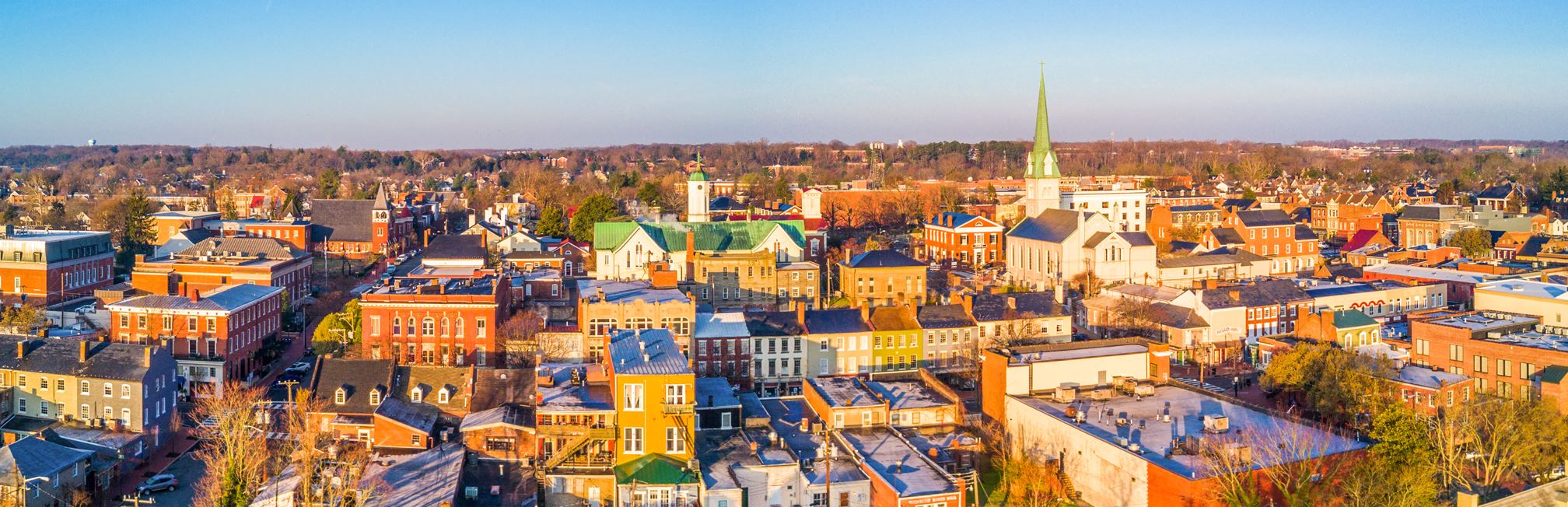
The Historic District is an overlay zoning district in downtown Fredericksburg established to protect its integrity as a historic city with a long history. Also present is a National Register Historic District covering a smaller area within the overlay zoning district. These districts in conjunction create a space that preserves Fredericksburg’s historic character while fostering a robust community. Notable structures such as Historic Kenmore, the Rising Sun Tavern, and the Mary Washington House provide locals and tourists alike the opportunity to immerse themselves in the architecture and stories of the past. Preserving Fredericksburg’s past is key to its economic development as tourism boosts the revenue of the city’s economy, providing jobs and infrastructure to the community.
The Historic District is comprised of forty blocks of Downtown Fredericksburg along with a few other areas. To find out if your property is located within the Historic District, go to FredGIS and apply the “Old and Historic Fredericksburg” overlay layer to see the full district. There is also a layer for the National Register District entitled “VDHR National Register Historic District,” which you can apply, but the one mentioned previously is more helpful for city related matters like COAs. If your house is within the displayed boundaries, you are in the Historic District and its associated guidelines apply to you. Alternatively, you can locate your property on this map.
The Architectural Review Board (ARB) is a panel of seven knowledgeable citizens appointed by City Council to review the applications submitted in accordance with the Historic District Ordinance. Terms of appointment are four years, and members can serve two consecutive terms. All members must have demonstrated interest, competence, or knowledge in historic preservation, and the Board must include a registered architect or architectural historian as well as a member with professional training or experience in architecture, history, architectural history, archaeology, or planning. City Council seeks volunteers with a range of specialties so that Fredericksburg has the benefit of their experience and perspective. More information regarding the ARB can be found here.
The ARB meets at 7:00pm on the second Monday of every month in the Council Chambers of City Hall, 715 Princess Anne Street, Fredericksburg, Virginia. Supplementary meetings, when needed, can be set for the fourth Monday of every month (5:30pm at City Hall). A link to further information can be found here (2024 Schedule).
A Certificate of Appropriateness, or COA, is the approval issued by the ARB for alterations to properties within the Historic District, and must be obtained prior to beginning any project, with the exception of routine maintenance. To determine if your project requires a COA, please contact staff and consult the Historic District Design Guidelines. Applications are submitted to the Community Planning and Building Department through the Citizen Access Portal (CAP). A checklist of requirements can be found here. A list of associated fees can be found here. An additional form is required for changes involving windows, which can be found here.
Depending on the changes you plan to make to your property, there are three possible fees associated with obtaining a Certificate of Appropriateness (COA) from the Architectural Review Board (ARB). If your project involves signs, fences, and/or accessory structures, the fee is $75. If you are planning to make alterations to or partially demolish part of your property, the fee is $150. If your project involves new construction, additions, and/or complete demolition on your property, the fee is $250. Further information regarding fees for planning services can be found here.
The ARB will review and decide on requests or applications within 90 days, typically within 4-6 weeks, of receiving the official submission of the application. Routinely the process takes approximately a month. A Certificate of Appropriateness will only be issued if a majority of all appointed ARB members vote in favor. The ARB staff will document the decision in writing, stating clearly how the Board applied the relevant standards to the application. This written decision will be provided to the applicant within 14 days of the decision date.
A Certificate of Appropriateness expires two years after the date of approval unless a building or sign permit has been obtained and remains in effect; or, prior to the expiration date, upon written request, the Zoning Administrator grants an extension of a certificate of appropriateness which shall not exceed one year from the expiration date, limited to a maximum of two such extensions.
Several projects do not require a COA, such as the replacement of deteriorated materials with identical ones, the repainting of painted surfaces, gardening and landscaping, interior modifications that do not affect the exterior, routine maintenance, and alterations that are not visible from the public right-of-way. If you are unclear about what projects require approval, please contact the City planning staff to discuss your project.
Direct replacement of any window requires approval by the Architectural Review Board. A building permit is also required for the replacement of any windows in the district. Any request for window replacement should be accompanied by a window assessment form and thorough photo documentation to determine the need for replacement. The form is available online here or from the Community Planning and Building Department. Further information regarding the replacement of windows in the Historic District can be found in the Historic District Design Guidelines.
Signs are reviewed under a separate sign permit rather than a COA application. Size and style of signs are governed by the City Code and the ARB will additionally review further details like materials, attachment types/wall mounts, and ensure consistency with the building or site’s architectural character. Exact sign allowance should be verified with the Planning Department (information here).
If a roof or its features (e.g. shingles) are damaged in a way that threatens or degrades the structural and visual integrity of the structure, it must be repaired. As is the case with siding, windows, and doors, replacing and repairing roof material will require a COA and building permit if you are in the Historic District.
The ARB does not review paint or paint colors of already painted surfaces. However, do not apply paint or other coatings to unpainted masonry, stucco, metal, or other traditionally unpainted materials. Ensure that you use appropriate surface preparation and application techniques for any painting project. A COA is required for unpainted materials.
Yes. The City of Fredericksburg has a program for partial exemption from the real estate tax increase for rehabilitating a qualifying residential building. The building must be in the Historic District and meet certain other criteria. Foremost among these is the requirement that an application be filed and an inspection of the property made by the Office of the Commissioner of the Revenue before any work or interior demolition begins.
Commercial buildings may also be eligible for rehabilitation exemption. They are not required to be in the Historic District but must conform to other criteria.
The Rehabilitation Tax Credit page provides more information regarding the Fredericksburg Rehabilitation Tax Exemption program.
Fredericksburg has an archaeology ordinance that incorporates the evaluation and protection of archaeological resources into the land development review processes. Archaeology allows for an understanding of history not available from any other source. The archaeological program encourages the identification and recording of archaeological resources, the avoidance of identified sites where possible, and, when sites cannot be avoided, the excavation and recovery of information. Once a site is disturbed, its information potential is permanently destroyed, so it is vital to capture this information through formal investigation. The ordinance requires preliminary investigation of sites when planning for development, and this early investigation can allow developers to reduce costs by avoiding highly sensitive areas where possible. For more information regarding Fredericksburg’s archeological ordinance, visit the relevant city ordinance (72-50.5).
A historic preservation easement is a voluntary legal agreement between a landowner and a qualified easement holding organization to protect a significant historic property, landscape, archaeological site, or anything that contributes to the integrity of a district. These easements limit your ability to make alterations to your property. There are a few organizations that hold historic preservation easements in the City of Fredericksburg, including the Historic Fredericksburg Foundation, Incorporated (HFFI), the Virginia Department of Historic Resources (DHR), the National Park Service (NPS) and other private organizations. If you want to know if your property is affected by a historic preservation easement, you should check with the relevant agencies such as HFFI or DHR to see if there is an easement registered for your property.
Page 148 of the Historic District Design Guidelines provides a glossary of relevant preservation terms.